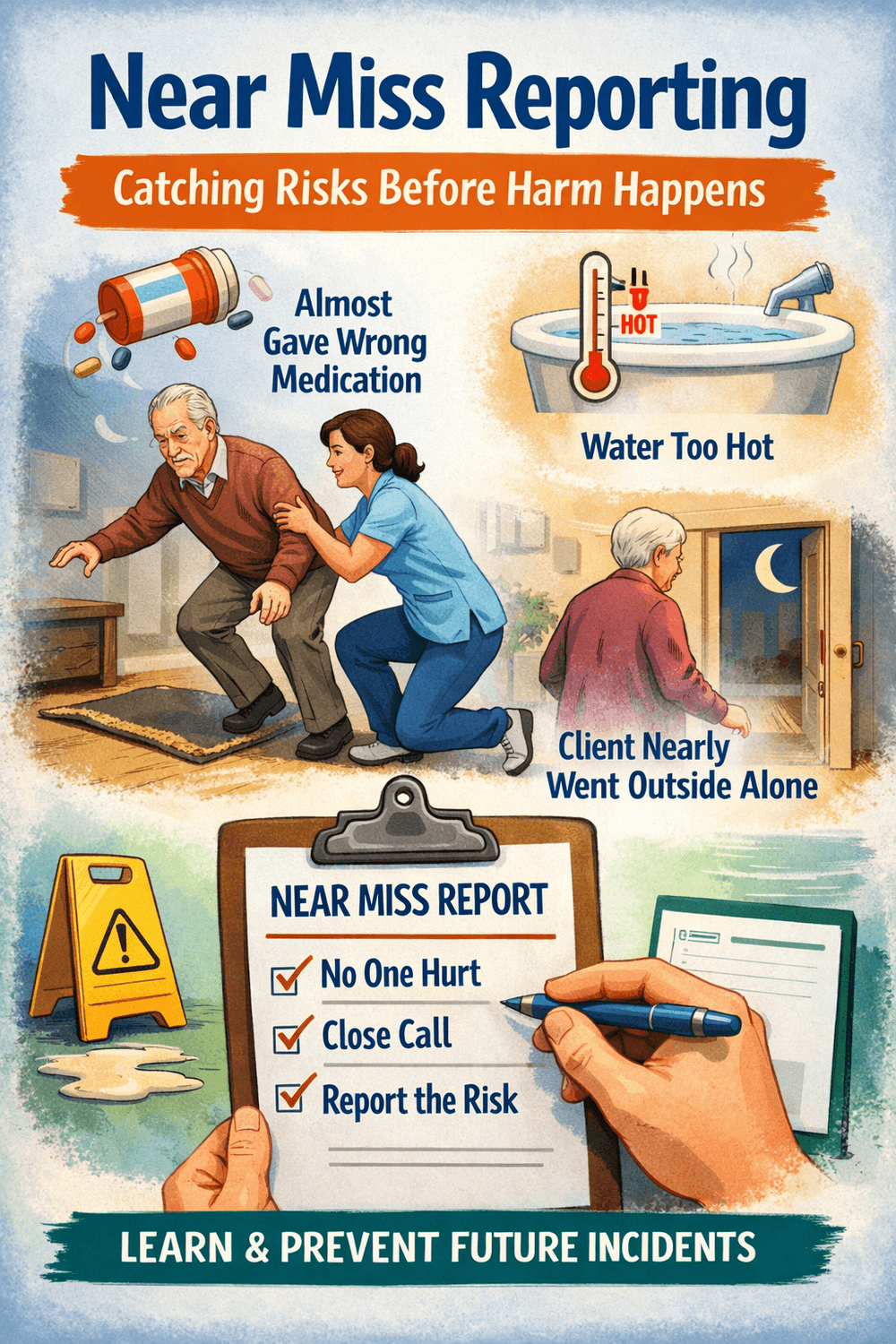
Reporting “Near Misses” — Why It Matters
In care work, we often focus on incidents that actually cause harm. But some of the most valuable lessons come from situations where something nearly went wrong but didn’t.
These are called “near misses.”
A near miss is any event that could have resulted in injury, harm, or a safeguarding issue — but didn’t, either by luck or quick action.
Many carers overlook them because “nothing actually happened.”
In reality, near misses are some of the most important things to record.
What is a Near Miss?
A near miss is an event where harm was narrowly avoided.
Examples might include:
A client almost falling but being caught in time
Medication almost given incorrectly but spotted before administration
Hot water running too hot before a client enters the bath
A loose rug noticed before the client trips
A client nearly leaving the house alone at night
No injury occurred — but the risk was real.
Why Near Miss Reporting Matters
Prevention of Future Harm
A near miss often reveals a hidden risk in the environment or routine.
Examples:
Lighting too dim in a hallway
Medication packaging causing confusion
Mobility equipment positioned incorrectly
Recording it allows the issue to be fixed before someone is hurt.
Identifying Patterns
One near miss might be chance.
But three similar near misses might reveal a bigger problem.
For example:
Multiple near falls near the same chair
Medication confusion during agency handovers
Repeated night wandering
Without recording them, these patterns are easily missed.
Professional Protection for the Carer
Documentation protects carers.
If something later does go wrong, your notes show:
You identified risks early
You reported them
You took action to reduce them
This demonstrates professional diligence.
Improving Care Plans
Near misses often highlight that a care plan needs updating.
For example:
A client now needs supervision when walking
Medication routines need clearer documentation
Equipment such as grab rails may now be required
Without recording the near miss, care needs may remain underestimated.
Examples of Near Misses in Care
Common situations include:
Mobility
Client lost balance but recovered using furniture
Walking aid almost slipped
Medication
Wrong medication almost administered but noticed in time
Medication dropped but not taken
Environment
Spillage noticed before client walked through it
Loose electrical cable across floor
Behaviour / Cognition
Client attempted to leave the house unsupervised
Client tried to use kitchen appliances unsafely
Personal Care
Water temperature too hot before bathing
Hoist sling incorrectly positioned but corrected before lift
What Should Be Recorded?
A near miss report should include:
Date and time
Location
What nearly happened
How it was prevented
Immediate action taken
Who was informed (family, nurse, GP etc.)
Recommendations to prevent recurrence
Why This Matters for Independent Carers
Independent carers often work without the structured reporting systems agencies use.
This can leave carers vulnerable if something later goes wrong.
Keeping clear near-miss records shows that you:
Monitor risk
Take safeguarding seriously
Act proactively to protect your client
It is a small habit that demonstrates professional standards of care.
Bottom Line
Near misses are early warnings.
They show us where risk exists before harm occurs.
Recording them isn’t about creating paperwork —
it’s about protecting clients, improving care, and protecting yourself as a professional.
✅ Pro Carer Circle Members:
A Near Miss Report Template is available in the Professional Documentation Library to help carers record these events clearly and consistently.
When in doubt — escalate. Observation is your role. Diagnosis is not.
If you’re a carer navigating pricing, boundaries, or professionalism in independent care — you’re not alone. This is exactly why communities like Just Care Community exist.