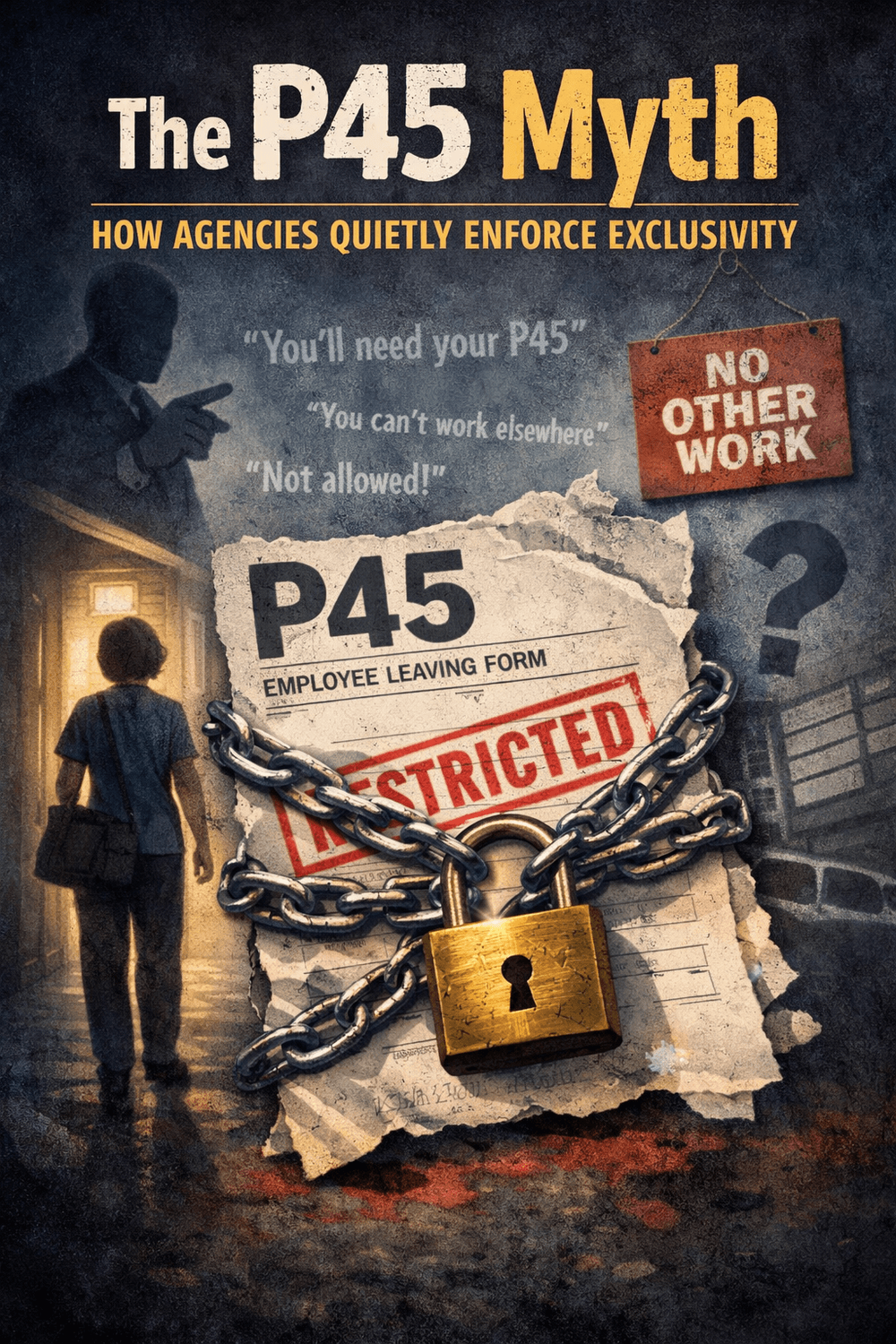
The P45 Myth: How Agencies Quietly Enforce Exclusivity
We recently came across a question on social media where a carer was being told she had to work exclusively for an agency. If you have come across this, either casually, or with a hint of menace, let's address it. If you have heard:
“If you leave us, we’ll issue your P45.”
“You can’t work elsewhere once your placement ends.”
“We’ll need your P45 before you take other work.”
It sounds official. Legal. Final.
And for many carers, it’s enough to stop them asking questions.
But here’s the truth, plain and simple:
A P45 is not a leash.
And it is not a legal tool to control your future work.
This article is about where that myth comes from, how it’s quietly used to enforce exclusivity — and why it matters more than people realise.
What a P45 Actually Is (and Isn’t)
A P45 is a tax document issued when an employment ends. That’s it.
It tells HM Revenue & Customs:
how much tax you’ve paid so far,
how much you’ve earned,
and which tax code you were on.
It does not:
restrict where you can work next
prevent you working for another agency
stop you becoming self-employed
create a “cooling-off” period
give an agency any power over your choices
A P45 is administrative, not contractual.
Yet in care, it’s often treated as something far more sinister.
How the Myth Is Quietly Used
Here’s how it tends to play out in the real world:
A carer finishes a placement
They mention picking up work elsewhere
An agency responds with:
“You’ll need your P45 first”
“That won’t be allowed”
“Our contract doesn’t permit that”
Sometimes it’s framed as:
protecting the client
preventing “conflicts”
maintaining standards
But in practice?
It’s about control.
And more often than not, it relies on carers not knowing their rights.
Exclusivity by the Back Door
Let’s be really clear.
🚫 Zero-hours contracts cannot legally enforce exclusivity
Even if a clause is written into the contract.
That means:
You can work for multiple agencies
You can take private clients
You can move on immediately after a placement
The law changed precisely because exclusivity in insecure work was exploitative.
Yet some agencies still try to:
imply you’re “not allowed”
discourage you through fear
blur the line between employment and self-employment
All without ever saying the word exclusivity.
That’s the quiet part.
Why Care Is Especially Vulnerable to This
Care workers are:
emotionally invested
often isolated on placements
reliant on steady income
conditioned to “not rock the boat”
Add in:
unclear contracts
rushed onboarding
inconsistent status (PAYE here, “self-employed” there)
…and you have the perfect conditions for myths like this to thrive.
Not because carers are naïve —
but because the system benefits when they stay unsure.
The Emotional Cost Nobody Talks About
This isn’t just about paperwork.
It’s about carers:
staying in poor conditions out of fear
turning down better work
feeling disloyal for wanting flexibility
believing they’ll be “blacklisted”
I’ve seen brilliant carers doubt themselves because of a single sentence said with confidence.
That matters.
Because confidence without truth is manipulation.
So What Can Agencies Legitimately Control?
Let’s be fair and balanced.
Agencies can:
enforce notice periods (if reasonable and lawful)
protect genuine business interests
prevent poaching during an active placement
They cannot:
stop you earning a living elsewhere
use a P45 as leverage
imply legal consequences where none exist
If something feels vague, threatening, or oddly informal — that’s usually your cue to pause and ask questions.
Why This Matters (Especially Now)
Care is changing.
More carers are:
working independently
combining PAYE and self-employment
seeking flexibility and fair pay
Old control tactics don’t fit this reality — but they haven’t disappeared.
Shining a light on them isn’t about attacking agencies.
It’s about raising standards and restoring balance.
A confident, informed carer is not a risk.
They’re the backbone of ethical care.
Final Thought
If someone needs a myth to keep you compliant, the problem isn’t you.
It’s the system relying on silence.
And silence is exactly what we’re done with.
If you’re a carer navigating pricing, boundaries, or professionalism in independent care — you’re not alone. This is exactly why communities like Just Care Community exist.